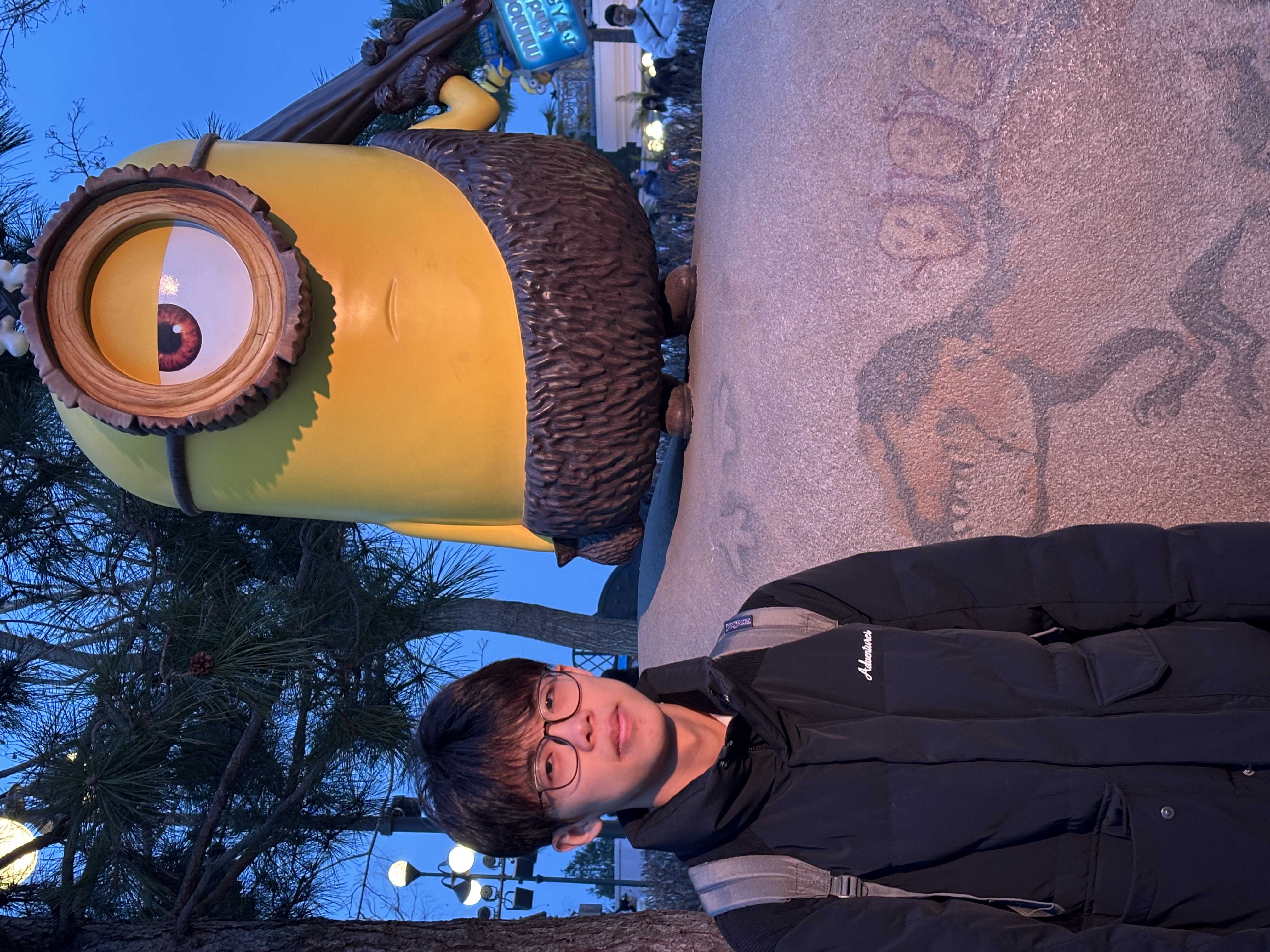
Junjie Hu (胡俊杰)
Master's Student in Transportation Engineering
👋 Hello! I'm Junjie Hu, a third-year Master's student at the School of Transport & Transportation Engineering, Central South University (CSU). I have the privilege of being advised by Prof. Jaeyoung Jay Lee, a distinguished researcher recognized among the top 2% of scientists globally in road safety. I am driven to analyze large-scale traffic data to uncover patterns that pave the way for safer, more intelligent, and sustainable transportation systems.

Research Interests
Traffic Spatio-Temporal Data Analysis
Vehicular Decision-Making & Control
Deep Learning in Transportation
Advanced Traffic Safety
Experience 💼
Education
Master of Engineering, Transportation Engineering
Bachelor of Engineering, Logistics Engineering
Professional Experience
Business Risk Modeling Intern
- Assisted in developing and validating credit risk models for bank partners using Python (Pandas, Scikit-learn).
- Pre-processed large-scale transaction data and engineered features to improve model accuracy.
- Contributed to a risk analysis report that provided data-driven insights for business strategy.
Volunteer
Volunteer Researcher
- Investigated transportation barriers for people with disabilities through field visits and surveys.
- Co-developed a crowdsourced mapping platform for accessible facilities.
- Project Demo: View Live Project
Honors & Awards 🏆
Scholarships
2025 — Outstanding Student of Central South University (Top 20 in the University)
2025 — President’s Excellence Scholarship of Central South University (Top 30 in the University)
2024,2025 — National Scholarship for Graduate Students, Central South University
2023, 2024,2025 — First-class Academic Scholarship, Central South University
Competitions
Third Prize, 15th China University Student Energy Conservation & Emission Reduction Competition
Third Prize (National), 7th National Undergraduate Logistics Simulation Competition
More than 7 Awards in Mathematical Modeling Competitions
Publications 📄
First & Corresponding Author
Hu, J., Hu, C., Yang, J., Bai, J., & Lee, J. J. (2024). Do traffic flow states follow Markov properties? A high-order spatiotemporal traffic state reconstruction approach for traffic prediction and imputation. Chaos, Solitons, and Fractals, 183, 114965. [Link]
📝 Contribution (Click to expand)
Designed a high-order traffic state reconstruction method demonstrating traffic flow's Markov property. Leveraged Markov matrix prior knowledge for high-accuracy traffic imputation tasks using an auto-encoder framework.
Hu, J., Bai, J., Yang, J., & Lee, J. (2024). Crash Risk Prediction Using Sparse Collision Data: Causal Inference and Graph Convolutional Networks Approaches. Expert Systems with Applications, 248, 125315. [Link]
📝 Contribution (Click to expand)
Created a crash data enhancement strategy utilizing historic priori spatial and temporal knowledge. Developed a novel method, Priori Spatial and Temporal Causal Graph Convolutional Network (PST-CGCN), for predicting crash risk based on causal inference and graph convolutional networks.
Hu, J., Zhang, J., Bai, J., & Lee, J. Dynamic Correlation Analysis of Urban Crashes Using Tucker-Net Based SIRS Model: A Case Study in New York City. Journal of the Franklin Institute, 107946. [Link]
📝 Contribution (Click to expand)
Designed a new data-driven and transferable analysis model, the Tucker-Net based Susceptible-Infectious-Recovered-Susceptible (SIRS) model (TNBSM), for exploring dynamic correlations within crash zones using tensor decomposition and the SIRS model.
Hu, J., & Lee, J. (2025). Car following dynamics in mixed traffic flow of autonomous and human-driven vehicles: complex networks approach. Physica A: Statistical Mechanics and its Applications, 665, 130519. [Link]
📝 Contribution (Click to expand)
Applied a coarse-grained phase space algorithm, introduced complex network technology into vehicle-following behavior analysis, and revealed distinct characteristics and differences between autonomous vehicles (AV) and human-driven vehicles (HV).
Hu, J., Gao, D., Lee, J., & Wang, L. Vehicle dynamics analytics based on complex network techniques: a trajectory-based visibility graph approach. Chaos, Solitons, and Fractals, 200, 117161. [Link]
📝 Contribution (Click to expand)
Introduced an adaptive trajectory-based visibility graph (TVG) framework, a novel method for dissecting vehicle dynamics by transforming planar trajectory data into complex networks. This framework features a tunable visibility tolerance coefficient, dynamically scaled by lateral displacement, enabling the TVG to capture geometric occlusions and maneuver-specific spatial scales.<
Hu, J., Bai, J., & Lee, J. Simplified and Efficient KNN-Based Method for High-Resolution Traffic Time-Space Diagram Imputation. (Manuscript under review).
📝 Contribution (Click to expand)
Proposed a modified K-Nearest Neighbors (KNN) framework for reconstructing and imputing Time-Space Diagrams (TSD) from sparse data by matching similar spatiotemporal neighborhood features defined by Queen Contiguity Spatial Rule.
Hu, J., Gao, D., Hu, C., Zhou, H., & Lee, J. Rethinking driving style recognition: A prediction error-based driving behavior modeling. (Manuscript under review).
📝 Contribution (Click to expand)
Revisited an end-to-end approach for driving style recognition by exploring driver behavior heterogeneity through trajectory prediction model errors. Utilized spatial attention and convolutional social pooling to learn interdependencies in vehicle motion and introduced a multi-modal distribution for future trajectories based on driving style.
Hu, J., Lee, J., & Wang, L. Re-examining the Explanatory Boundaries of Car-Following Models: From a Systematic Decomposition of Fitting Errors to the Revelation of Adaptive Feedback Mechanisms. (Manuscript under review).
📝 Contribution (Click to expand)
Posited that residuals of car-following (cf) model are a composite of structural errors and random error and utilized an Unobserved Components Model to decompose the residual series from three calibrated CF models.
Hu, J., Bai, J., &Lee, J. Meta-Learning Guided by Physics-Based Residual Priors: A Plug-and-Play Training Strategy for Lightweight Car following Models. (Manuscript under review).
📝 Contribution (Click to expand)
Introduced a plug-and-play framework named Residual-Aware Meta-learning Re-weighting (RAMR), which reframes the Car-following model training problem as a bilevel optimization task. Comparative experiments were conducted on four datasets, applying three classical physical CF models and three data-driven predictors to comprehensively validate the efficacy and versatility of RAMR.
Wang, L., Lee, J.,Hu, J *. The Resilience Benefit of Disorder: A Global Typological Analysis of Road Network Morphology and Urban Performance. (Manuscript under review).
📝 Contribution (Click to expand)
Using a global dataset of 70 cities, Contributed to investigating how road network morphology, quantified by directional entropy, affects key metrics of urban sustainability and resilience, including CO₂ emissions, commute times, and congestion.
Co-authored
Yang, J., Lee, J., Mao, S., & Hu, J. (2024). Dynamic safety estimation of airport pick-up area based on video trajectory data. IEEE Transactions on Intelligent Transportation Systems, 25(2), 1774–1786. [Link]
📝 Contribution (Click to expand)
Assisted in designing a modified CUSBoost algorithm for imbalanced trajectory data classification, leveraging four risk indicators and spatial distribution analysis.
Wang, L., Lee, J.,Hu, J., Yang, Y., & Mao, S. Analysis of injury severity of single-vehicle and two-vehicle crashes with lightweight vehicles (kei cars) in Japan: A random parameters approach with heterogeneity in means. (Accepted by Traffic Injury Prevention).
📝 Contribution (Click to expand)
Contributed to investigating K-car crash injury severity using a random parameters probit model with heterogeneity in means. Designed an out-of-sample prediction approach to clarify heterogeneity among various crash severity mechanisms.
Wang, L., Lee, J.,Hu, J., & Mao, S. Contributing Factors to the Severity of Crash Injury and Vehicle Damage Involving Japanese Lightweight K-cars: Considering Unobserved Heterogeneity. (Manuscript under review).
📝 Contribution (Click to expand)
Contributed to model design.
Hu, C., Tang, J.,Hu, J., Wang, Y.,Li, Z., Zeng, J., &Han, C. Dynamic partitioning of heterogeneously loaded road networks: A two-level regionalization scheme with Monte Carlo tree search. Transportation Research Part C: Emerging Technologies, 180, 105341. [Link]
📝 Contribution (Click to expand)
Contributed to model design.